The 70 Series was never sold new in the US, which is exactly why it fascinates American Land Cruiser fans. Thanks to the 25-year rule, more and more of them are crossing the border: BJ73s, BJ74s, HZJ73s and KZJ73s show up in import listings, overland builds and trailheads. The codes all look alike, but the trucks behind them can be quite different under the hood. Here's how to make sense of them.
The 70 Series at a glance
The 70 Series took over from the 40 Series in 1984. It's Toyota's "Heavy Duty" Land Cruiser line, the tough work trucks, and it is still built in some countries today. For the story of its predecessor, read our FJ40 history.
As with the 40 Series, the code reads in three parts: the first letter or letters for the engine, J for Land Cruiser, and the digits for series and wheelbase. The first digit is a 7; the second tells you the length:
- 0: short wheelbase (BJ70, LJ70, HZJ70, KZJ70, FJ70);
- 3 and 4: medium wheelbase (BJ73, BJ74, LJ73, HZJ73, KZJ73, FZJ73);
- 5, 6, 7, 8, 9: long wheelbase (HZJ75, HZJ78 and others).
All the engine letters are covered in our guide to Land Cruiser model codes.
70 Series models at a glance
| Code | Engine | Displacement | Years (approximate) | Wheelbase |
|---|---|---|---|---|
| BJ70 | 3B four-cylinder diesel (about 90 hp) | 3.4 L | from 1984 | short |
| BJ73 | 3B four-cylinder diesel (about 90 hp) | 3.4 L | from 1984 | medium |
| BJ74 | 13B-T direct-injection turbo diesel | 3.4 L | varies by market | medium |
| LJ70 | 2L-T turbo diesel | 2.4 L | about 1985-1990 | short |
| LJ73 | 2L-T turbo diesel | 2.4 L | about 1985-1990 | medium |
| HZJ70 | 1HZ inline-six diesel (about 130 hp) | 4.2 L | from 1990 | short |
| HZJ73 | 1HZ inline-six diesel (about 130 hp) | 4.2 L | from 1990 | medium |
| KZJ70 | 1KZ-T turbo diesel (about 125 hp) | 3.0 L | about 1993-1996 | short |
| KZJ73 | 1KZ-T turbo diesel (about 125 hp) | 3.0 L | about 1993-1996 | medium |
| FJ70 | 3F gas | 4.0 L | varies by market | short |
| FZJ73 | 1FZ gas | 4.5 L | varies by market | medium |
| HZJ75, HZJ78 | 1HZ inline-six diesel | 4.2 L | varies by market | long |
BJ70, BJ73 and BJ74: the diesel BJs
BJ70 and BJ73: the 3B engine
The BJ70 and BJ73 carry over the 3.4-liter 3B four-cylinder diesel, about 90 hp, already known from the BJ42 in the 40 Series. The BJ70 is the short version, the BJ73 the medium wheelbase. Simple and non-turbo, they're loved for mechanicals that any patient owner can work on.
BJ74: the 3.4-liter turbo
The BJ74 uses the 13B-T, a 3.4-liter direct-injection turbo diesel. Same medium wheelbase as the BJ73, with a more modern and stronger engine.
LJ70 and LJ73: the Light Duty branch
The LJ70 and LJ73 are a special case. They use a 2.4-liter 2L-T turbo diesel, roughly from 1985 to 1990, and belong to the lighter "Light Duty" line. That branch is the ancestor of the Prado. Their wheelbases follow the 70 Series pattern (short for the LJ70, medium for the LJ73).
HZJ73 and KZJ73: inline-six or turbo
HZJ70 and HZJ73: the 1HZ six
From 1990, the 70 Series gets the 4.2-liter 1HZ diesel inline-six, about 130 hp. The HZJ73 is the medium wheelbase version, the HZJ70 the short one. The 1HZ is naturally aspirated: no turbo, lots of torque, and a reputation that makes it a favorite for long-distance overlanding.
KZJ70 and KZJ73: the 1KZ-T turbo
From roughly 1993 to 1996, you'll also find the 1KZ-T, a 3.0-liter turbo diesel of about 125 hp, in the KZJ70 and KZJ73. They get close to HZJ power from a smaller engine, thanks to the turbo.
BJ73 vs HZJ73: what really changes
This is the comparison buyers ask about most.
| BJ73 | HZJ73 | |
|---|---|---|
| Engine | 3B, four-cylinder | 1HZ, inline-six |
| Displacement | 3.4 L | 4.2 L |
| Power | about 90 hp | about 130 hp |
| Available | from 1984 | from 1990 |
| Wheelbase | medium | medium |
So BJ73 vs HZJ73 is above all about the engine: the HZJ73 is clearly stronger on the highway, the BJ73 older and simpler. The body, on the other hand, doesn't change in any way that matters for a soft top: same medium wheelbase, same tub, same rear closure. One top fits both.
Importing a 70 Series into the US
Because the 70 Series was not sold new here, every truck you'll find is an import. The federal 25-year rule generally lets older vehicles in without meeting current US standards, and each model becomes eligible as it reaches that age. Rules and state titling practices can change, so ask for the complete import file, make sure the title is clean, and check with your state's DMV and your insurer before you buy.
Listings aren't always accurate either. An HZJ73 is sometimes advertised as a BJ73, or the other way around. Trust the ID plate, not the ad.
Why 70 Series owners love a soft top
Many imported BJ73s, BJ74s, HZJ73s and KZJ73s arrive with a hard top, factory steel or fiberglass, which keeps out cold, noise and thieves.
A soft top brings something else: open-air driving on nice days, a lighter truck and a look closer to the classic canvas-topped versions. Plenty of owners keep both and swap with the seasons. Our soft top vs hard top comparison goes through the pros and cons point by point.
One soft top for the 70 Series
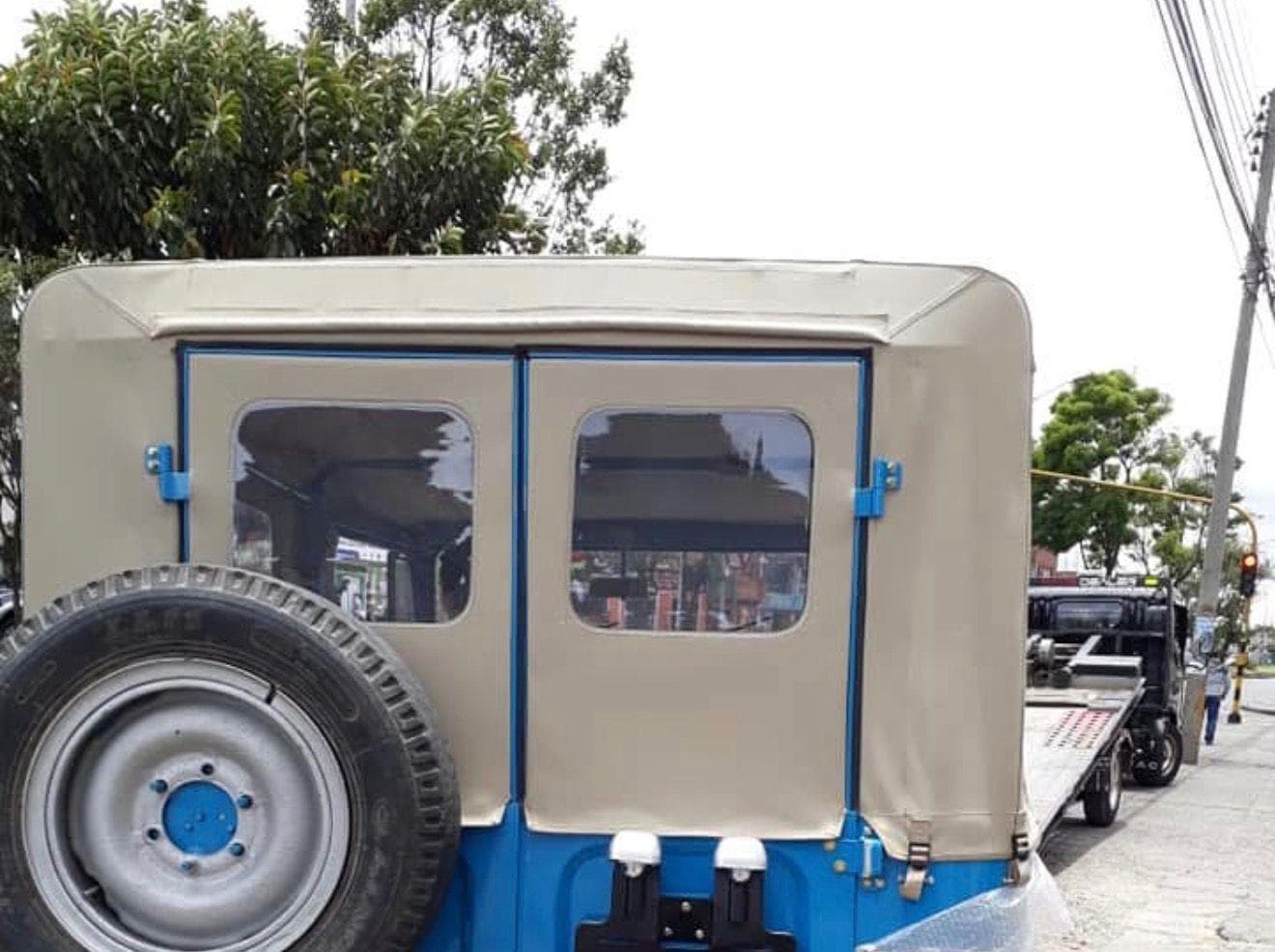
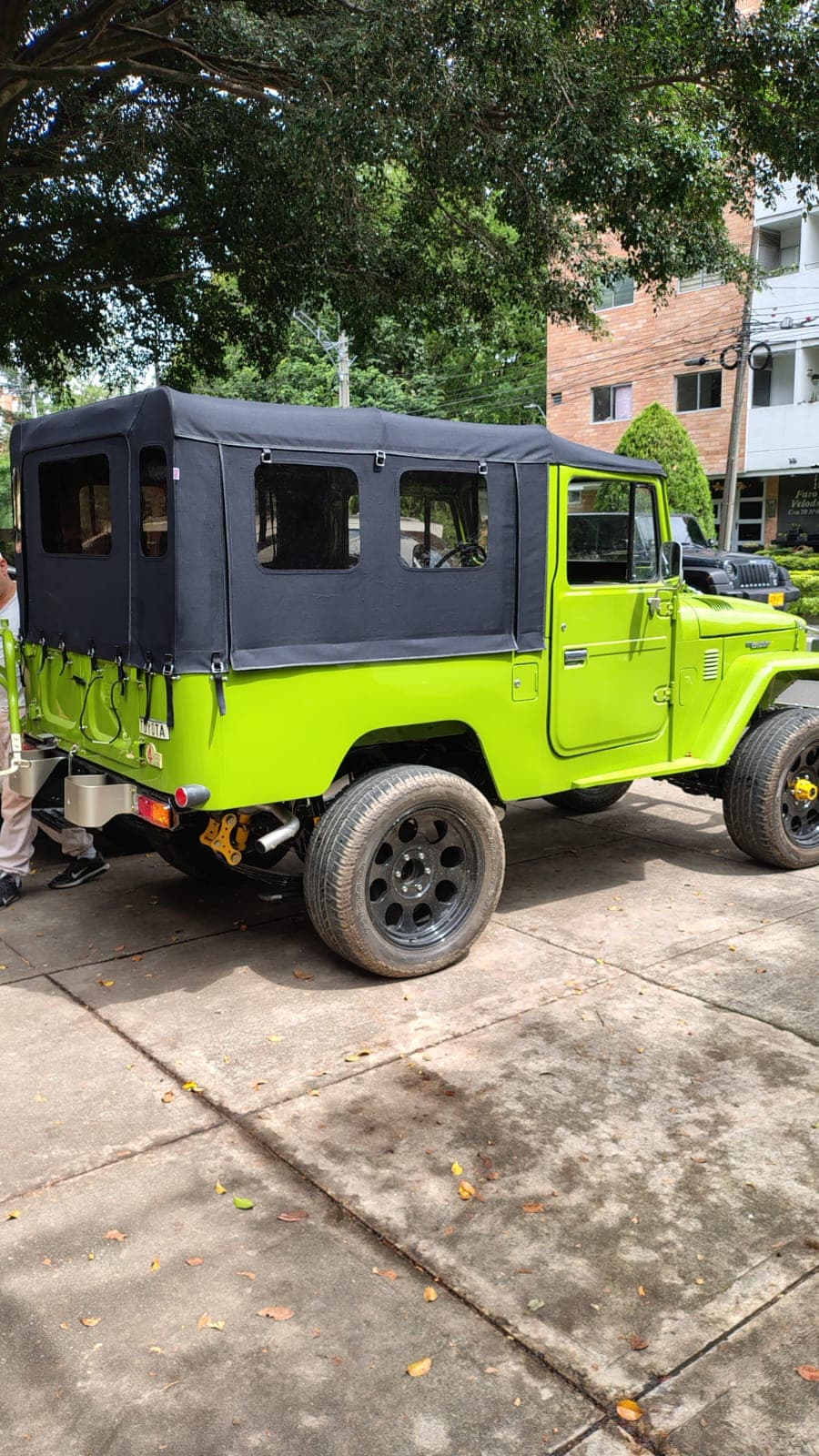
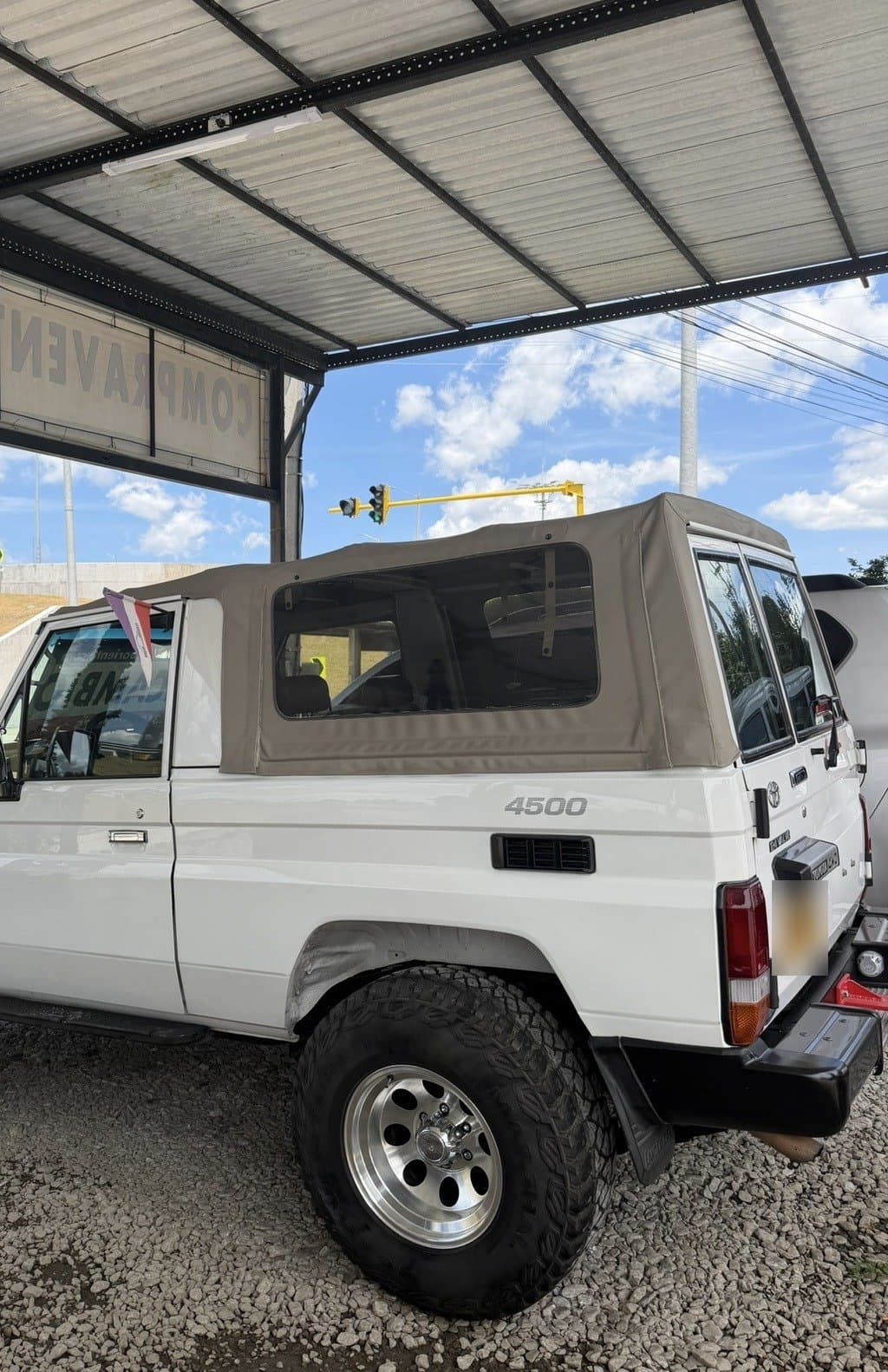
Our 70 Series full soft top fits the following models: BJ70, BJ73, BJ74, HZJ70, HZJ73, KZJ70, KZJ73, LJ70, LJ73, FJ70, FZJ73. All of them share the same rear closure.
- roof, sides, rear window and large side windows;
- UV-treated vinyl, waterproof and easy to clean;
- cut to Toyota's original pattern and handmade by Land Cruiser upholstery specialists in our workshop in Medellín, Colombia (About us);
- mounts on the original bows and factory fasteners, with no drilling or modification;
- YKK marine-grade zippers, stainless hardware, welded seams;
- tan or black, clear or lightly tinted windows.
It ships without bows, with its hardware, and with free tracked shipping to the US in 1 to 4 weeks. All the details are in our Land Cruiser 70 Series soft top article.
Identify your 70 Series before ordering
Before buying a top or any part, confirm the exact code:
- the ID plate in the engine bay shows the model code;
- the frame number is stamped on the chassis and should match your import and title paperwork;
- your title and import documents often list the model code or frame number.
A truck may have been re-engined: a BJ73 with a different engine is still a medium wheelbase, and the top stays the same. If in doubt, send us a photo of the side and rear through our contact page, or go straight to the Land Cruiser 70 Series soft top.
FAQ
What's the difference between a BJ73 and an HZJ73?
The engine: the BJ73 has a 3.4-liter 3B four-cylinder diesel (about 90 hp), the HZJ73 a 4.2-liter 1HZ inline-six diesel (about 130 hp), from 1990. Both share the same medium wheelbase and body, so the same soft top fits both.
What engine does the BJ74 have?
The BJ74 uses the 13B-T, a 3.4-liter direct-injection turbo diesel. It shares the BJ73's medium wheelbase.
What is a KZJ73?
It's a medium wheelbase 70 Series Land Cruiser with the 1KZ-T, a 3.0-liter turbo diesel of about 125 hp, built roughly from 1993 to 1996.
Was the 70 Series sold in the US?
Not new. Many have since been imported under the 25-year rule, which is why BJ73s, HZJ73s and KZJ73s are increasingly common in the US. Check titling rules with your state's DMV before buying.
Will your 70 Series soft top fit an HZJ75?
No. The HZJ75 and HZJ78 are long wheelbase trucks with a different body. Our 70 Series top fits the short and medium wheelbases (BJ70, BJ73, BJ74, HZJ73, KZJ73 and more). For a long wheelbase, contact us.
Not sure which top fits your truck? Send us a photo of your Land Cruiser and we'll get back to you quickly.